Sunday, May 20, 2012

A strong delusion.

2 Thessalonians 2: 11-13 And for this cause God shall send them strong delusion, that they should believe a lie: That they all might be damned who believed not the truth, but had pleasure in unrighteousness. But we are bound to give thanks always to God for you, brethren beloved of the Lord, because God hath from the beginning chosen you to salvation through sanctification of the Spirit and be life of the truth.
Without going into all the verses we're going to talk about strong delusion. Paul said these people did not receive the love of the truth. Consequently, God would send on them a deluding influence that they may believe what is false. God is permitting the "delusion” to take place. ‘They perish because they did not accept the love of the truth. For this reason’ they experience delusion. As in Romans 1:24–25 (‘God delivered them over … They exchanged the truth of God for a lie.’) The delusions certain people experience reflect God’s response to a prior decision on their part.
During the first century there was a 'great apostasy' happening because Jesus failed, to do what they expected of their Messiah. Many did not believe Jesus was the real Messiah in prophecy and were going apostasy. Israel wanted her types and shadows to be fulfilled in a literalistic or a nationalistic manner being blinded by the earthly or carnal system of Moses.
"In classical Greek the word apostasia denoted a political or military rebellion; but in the Greek Old Testament we find it used of rebellion against God 1 Samuel 8:7, and this becomes the accepted Biblical usage. Paul's thought is that in the last times of the old covenant there will be an outstanding manifestation of rebellion against God.
Because of this rebellion against God and willful belief that the Messiah was going to restore the kingdom in a literalistic or a nationalistic manner God send them a strong delusion, that they should believe that lie.

How was this strong delusion sent by God accomplished? The Jews foolishly believed the time had come for them to “throw off the Roman yoke” and thereby establish the kingdom they thought was in their prophecies. This proved to be Israel’s complete destruction.
Rome did not initiate the war against Jerusalem. Jerusalem was under the authority and control of Rome. Headstrong men in Jerusalem itself believed the time had come to throw off the Roman yoke. They kept irritating the people and inciting them to rebel against Rome.
In November of 65 the great Jewish revolt against Rome broke out at last. The people quit paying their taxes. This would have been sufficient in itself to cause Rome to turn against Jerusalem. Jewish Zealots had driven all Roman forces from Jerusalem and had actually slain more than 600 Roman troops.
Agrippa appealed to the people of Jerusalem to be mindful of the great multitude of nations that were already living peaceably under the authority of Rome with no intention of rebelling and should Jerusalem as one nation, take up arms against the mighty Roman empire?
Agrippa temporarily stopped the Jewish revolt against Roman that was threatened, and the people started again paying their taxes. But that peace was short and time provide a fulfillment of Agrippa warning. Feeling kept building up and the war was on its way. (Josephus, p 1870)
Nero sent Vespasian to Judaea to stop the rebellion. His commission from Nero was in 67 A.D. and the declaration of war against Judaea occurred in the early part of February of that year. It was three years and six months later, on August 10, 70 A.d., Jerusalem was destroyed. So there was a price to pay for rejecting the Messiah and refusing the kingdom he came to establish.

Saturday, April 28, 2012

The transfiguration

Moses and Elijah were considered to be Israel’s greatest prophets sent by God.   How does this relate to the transfiguration?  Let's look into the historical setting.   The account of the transfiguration of Jesus Christ is recorded in Mark and parallel passages are found in Matthew 17:1-3 and Luke 9:28-36.

We will examine the account of Luke.   The identity of Jesus is the central issue that Luke deals with in chapter 9.   Herod, we are told by Luke, was very interested in the identity of Jesus.   He was aware that some thought Jesus was Elijah or some other prophet, raised from the dead, and he feared that Jesus might be John the Baptist, raised from the dead, since he had put him to death (9:7-9).

When Jesus asked the disciples who the people thought Him to be, they gave the same answers that Herod had heard (9:19). So they answered and said, "John the Baptist, but some say Elijah; and others say that one of the old prophets has risen again."

When Jesus pointedly put the question to His disciples, Peter spoke up, with the most profound statement he has made, up to this point: “The Christ of God” (9:20).  Jesus strictly warned them and commanded them to tell this to no one.   Jesus went on to tell His disciples, He must suffer many things, and be rejected by the elders and chief priests and scribes, and be killed, and be raised the third day."   He tells the disciples that there would be a “cross” for them to bear as well, if they would follow Him. (9:23-25)    

From man’s perspective, one must save his life in order to live, but Jesus taught that His followers must give up their lives for Him, in order to live.  Life, He said, comes out of death. On the other hand, those who would seek to save their own lives will ultimately lose them.

Jesus then tells his disciples there are some standing here who shall not taste death till they see the kingdom of God." (9:27)    While the identity of Jesus as Israel’s Messiah was not acknowledged by the masses, of Israel or the political leaders (e.g. Herod), nor by the religious leaders, Peter had just confessed that Jesus was God’s Messiah.   Jesus Himself affirmed this profession, and then hastened to go on, spelling out the suffering and death that this necessitated.   Now it is time for God the Father to give the final word, as is done in the transfiguration.  Here, Jesus is given the Father’s stamp of approval as His appointed King of Israel.   

After six days Jesus took Peter, James, and John with him and led them up a high mountain, where they were all alone.  We do not know exactly what time it was, nor how long our Lord had been in prayer.  Luke tells us, they were sleepy and when they were fully awake, they saw  Jesus and two men were standing with Him. (9:32)    

 As Jesus prayed, the appearance of His face was altered.   His clothes became dazzling white, whiter than anyone in the world could bleach them.   And there appeared before them Elijah and Moses, who were talking with Jesus.   Peter said to Jesus, 'Rabbi, it is good for us to be here.  Let us put up three (tabernacles) shelters - one for you, one for Moses and one for Elijah.' (He did not know what to say, he was so frightened.)

 Mark informs us that it was out of fear that Peter blurted out these words, informing us that all three were frightened by the splendor of the site of the transfiguration.  Mark 9:6 because he did not know what to say, for they were greatly afraid.    

Peter’s words were not carefully thought through because of fear, but they did mean something. What, then, was Peter suggesting?  What Peter said was so foolish because he was making Jesus equal, too Elijah and Moses.   He wanted to make one tabernacle for each of them.  However, Jesus isn’t just another great  prophet like Moses or Elijah, or even greater than Moses or Elijah.   Jesus is the Son of God.

Then a cloud appeared and enveloped them, and a voice came from the cloud: 'This is my Son, whom I love.   Listen to him! (9:35)      Lest explore the implications of the transfiguration and the observation that should be made when the voice came from the cloud saying “This is my Son listen to him.”

Notice suddenly, that after God’s voice came from the cloud, saying “This is my Son, listen to him” the disciples “no longer saw Elijah and Moses.”  (Luke 9:35-36)  Jesus was found alone.  (The splendor and glory of Jesus was so great that it overshadowed the greatness of Moses and Elijah and Jesus was found standing there all alone. That is the point the transfiguration of Jesus wanted the disciples and us to understand.   Jesus is superior to Elijah and Moses.    The glory of Jesus as God’s only Son overshadowed the greatest of Israel’s prophets.   In other words Moses and Elijah faded away in the Majestic Glory of Christ and they were no longer seen.

Under the old covenant Moses was elected to speak to Israel for God.  Exodus. 20:18-19 "When the people saw the thunder and lightning and heard the trumpet and saw the mountain in smoke, they trembled with fear. They stayed at a distance and said to Moses, "'Speak to us yourself and (we will listen.)  But do not have God speak to us or we will die." (emphasis mine)

The time had come for the disciples to lay aside their high regards and great esteem for Moses and Elijah and hear  God’s only Son.    This message is repeated a third time to the nation of Israel in Hebrews 1:1-3 God, who at various times and in various ways spoke in time past to the (fathers by the prophets, has in these last days (spoken to us by His Son, whom He has appointed heir of all things), through whom also He made the worlds; who being the brightness of His glory and the express image of His person, and upholding all things by the word of His power, when He had by Himself  purged our  sins, sat down at the right hand of the Majesty on high, (emphasis mine)

The first time the message was hard was when Jesus came from Galilee to the Jordan to be baptized by John. (Matthew 3:13-17)   

The word "transfigured" is a very interesting word. The Greek word is "metamorpho" and it means to transform, literally or figuratively to metamorphose, or to change. The word is a verb that means to change into another form.   It also means to change the outside to match the inside.  Jesus' divine nature was "veiled" in human form.   Hebrews 10:20 by a new and living way which He consecrated for us, through the veil, that is, His flesh,

At the transfiguration, Jesus was changed  outward so that it matches the inward reality and it was a glimpse of that glory.   Therefore, the transfiguration of Jesus  displayed the Shekinah glory of God incarnate in the Son.    The transfiguration of Jesus  was a unique display of His divine character which Jesus had before He came to earth in human form.

In the Old Testament law three witnesses were required to attest to any fact, was satisfied both in earth and in heaven.  Deuteronomy 19:15  "One witness shall not rise against a man concerning any iniquity or any sin that he commits; by the mouth of two or three witnesses the matter shall be established.   The three disciples are a demonstration to the three  witnesses that  Jesus Christ was who He claimed to be.    Later, Peter tells how he witnesses the Majestic Glory, of Christ (2 Peter 1:16-18)

Another interesting thing that takes place is in Luke 9:30-31 And, behold, two men talked with Him, who were Moses and Elijah, who appeared in glory and spoke of His decease which He was about to accomplish at Jerusalem. What did they talk about? Elijah and Moses were interested in the outworking of God’s plan through Jesus. They spoke about what Jesus was about to accomplish at Jerusalem (Luke 9:31).    This is powerful.

God tells us that his prophets made inquiring about  what they were prophesying about? (See 1 Peter 1:10-12)  They did not understand the words that the Spirit of God was putting in their hearts concerning the times of the gentiles. They only know there would come a suffering Messiah to redeem the gentiles along with Israel, but they did not know who or in what time or dispensation this would come to pass.  The only revelation they were given concerning this glorious Gospel is that they were ministering to a people who had not yet come into existence.

Now  Elijah and Moses are standing face to face with Jesus talking about what he would accomplish at Jerusalem.  They now know the who, (Jesus) they are prophesying about and the time, and dispensation, of the coming of the Messiah.   What a wonderful thought the scripture gives us.

So the transfiguration of our Lord played a very significant role in the unfolding of God’s plan and purpose for Jesus, the Christ of God.   It affirmed in a dramatic way, that Jesus is the Son of God who is superior to Elijah and Moses.  The one who would fulfill all the hopes of Israel the Messiah.

Saturday, March 17, 2012

The story of the Samaritan woman at the well.

The story of the Samaritan woman at the well makes a strong statement about Jesus breaking down the dividing wall of hostility between Jews and Gentiles at that time. Jesus blithely disregarded the ancient enmity between the two groups. The Samaritan woman at the well is an episode in the life of Jesus that appears only in the Gospel of (John 4:4-26).

During the course of his journeys, Jesus traveled from Judea in the south back to Galilee in the north, going via Samaria. Normally, Jewish travelers made a detour around Samaria to avoid contact with Samaritans, but Jesus took the direct route. He came to Sychar, which was a town near Jacob’s Well.

There had once been a great city there, just where this incident took place. Nearby on the peak of Mount Gerizim had been a temple that rivaled the Temple of Jerusalem. All this had been destroyed before the time of Jesus, and only a village remained. Jesus stopped, tired and thirsty in the midday heat. The disciples had gone to the town to buy food. Only a Samaritan woman was there, drawing water from the well. Every drop of water used in a household had to be carried from the local well. So every day woman walked to the well, filled their heavy earthenware jars, and carried the water home.

Jesus asked the Samaritan woman for something to drink, and here begins the longest conversation. It is surprising that this conversation happens with someone who was a woman, and non-Jewish. The woman herself was certainly surprised when Jesus spoke to her, because Jews and Samaritans did not have anything to do with each other. (John 4: 9) There had been a long-running conflict between the Jews and the Samaritans. By the time of Jesus, the Jews thought that the people who lived in Samaria were not true descendants of the great Jewish ancestors, and that their religion was not true Judaism but a mixture of beliefs.

At this stage the story contains a great deal of symbolism. Jesus began talking to the woman about ‘living water.’ Naturally, this caught the interest of the woman, as she was burdened with the daily task of carrying water. She asked Him, "Sir, You have nothing to draw with, and the well is deep and are you greater than our father Jacob, who gave us the well, and drank from it himself, as well as his sons and his livestock?" Jesus explained that when people drink ordinary water, they get thirsty again. But he had water springing up into everlasting life." The women ask him for some of this water so she may not thirst again. (John 4:15)

Jesus then told her to go and get her husband. She did not have one, she replied. 'You have had five husbands, said Jesus, but the man you are living with now is not your husband.' The woman understood Jesus’ meaning immediately. The woman called him a prophet, and began asking him about the differences between Samaritan and Jewish worship. She knew that the temple on nearby Mount Gerizim had been the central place of worship for the Samaritans, rivaling the Temple in Jerusalem. Samaritans and Jews always argued over which of the two temples was the true place to worship. Basically the woman was talking with Jesus about where and how you should worship God, an issue that interested her. Jesus told her that very soon none of these arguments would matter, they would not worship on Mount Gerizim or in Jerusalem. "But the hour is coming, and now is, when the true worshipers will worship the Father in spirit and truth; (John 4:21-23)

Then the woman said to Him, "I know that Messiah is coming" (who is called Christ). "When He comes, He will tell us all things." Jesus said I am he. Note that the disciples are surprised when they returned that Jesus is talking to a Samaritan woman. (John 4:27) They are surprised that he is talking to a Samaritan, 30AD, Samaritans were viewed with great suspicion. Jesus was showing his disciples then the situation was changing, and the Samaritans would also be a part of the household of God.

The woman left the water jar she has brought and hurried back to the town. ‘She said to the people, “Come and see a man who told me everything I have ever done! He cannot be the Messiah, can he?” They left the city and went on their way to him.’(John 4:28-30) Leaving her water jar behind seems like a trivial piece of information, but it parallels other incidents in the gospels, when various men left their everyday pursuits, abandoning fishing nets or tax collection tables to immediately respond to Jesus. The Samaritan woman did the same thing, but on her own initiative. The woman told everyone about Jesus, suggesting that he might be the Messiah.

In the meantime, the disciples of Jesus urged him to eat. But Jesus refused, saying that he has eaten food they did not know about. Jesus extended the idea to give it a spiritual dimension.

Then Jesus talked about the harvest. He was not referring to a harvest of foodstuffs, but to the many Samaritan who would believe in him. Among them were the Samaritan townspeople, who had listened to the words of the woman. (John 4:39-42) Many people believed in Jesus, not just because of the woman, but because they have seen for themselves that Jesus was the Saviour of the world.

Inclusion of the Samaritans among those whom Jesus favored was revolutionary, since there was bitter enmity between the Jewish and Samaritan peoples. Jesus was extending out God’s hand in love. The woman told many about Jesus. In this, she acted as an apostle, going out to tell people about Jesus, and bringing them to him.‘Many Samaritans from that city believed in him because of the woman’s testimony “He told me everything I have ever done”. So when the Samaritans came to him, they asked him to stay with them, and he stayed there two days.’(John 4:39-42)

In this story, of the Samaritan woman it shows the experienced the progressive stages of faith in Jesus. She met a Jew learnt about him, and came to believe in him. It did not matter that she was a woman and a Samaritan to Jesus. Gender and nationality were not important. No one was excluded from the Christian community. This was a lesson Paul would soon have to learn.

Sunday, March 11, 2012

Paul talks about Elijah and says, God has not cast away His people whom He foreknew.


In Romans 11:4-5 Paul talks about Elijah and says, God has not cast away His people whom He foreknew.

From the early days of Christianity there was a misunderstand about God’s promises to Israel. Paul understood, that everything stands or falls on the promises of God to Israel. Paul wanted to rid any idea that God was not keeping those promises completely.

Nationalistic Israel has rejected their Messiah and some thought God had rejected all of Israel. Thus, the logical question is this: HAS GOD REJECTED THEM? "Has God cast away His people?" Paul’s answer this question with a strong NO: God forbid! May such a thought has never entered our minds! Perish the thought! (Romans 11:2-3) Paul’s main argument in this chapter is made up of two parts:
 
1) God has not cast away His people whom He foreknew. Paul is actually quoting from the Old Testament. Read 1 Samuel 12:22 and Psalms 94:14. Paul offers himself as the number one proof that God has not cast away His people. I am an Israelite, of the seed of Abraham, of the tribe of Benjamin. Phil. 3:5)

This is important because there are those today who wrongly teach the Church is God’s plan B. According to this popular view, God's clock ran flawlessly until the coming of the Messiah. Then suddenly the clock stopped ticking because Israel failed to accept their Messiah, something that was not foreseen by the Omniscient God. God knew the Jews would reject their Messiah. Daniel 9 tells us that the Messiah would be cut off, or killed, and Isaiah 53 speaks of the suffering servant.

God had to change His plans to plan B the Church. During the ensuing parenthesis of time, God turned His focus to the Gentiles and created the Church. The Church, you see, was only a parenthetical stop gap unseen by the Old Testament prophets. As a result, the kingdom is no longer near, but postponed." At the end of the Church age (never mind the Bible says the Church age has no end. ) Daniel 7:14; Hebrews 13:20.
God well then again start the clock and deal with the Jews. National Israel will replace the church, at the end of the age. However, God’s plans for Israel was right on track. Paul’s main argument is he is an Israelite, of the seed of Abraham, of the tribe of Benjamin. The Church is not plan B. There were no gentiles in the Church for the first ten years.

2) At that present time there is a remnant according to the election of grace. Paul was familiar with the Old Testament and he knows the history of Israel. The word remnant originates from the Hebrew, and it comes from three Hebrew words. First, peletah or palet, meaning "what escapes," "those who escape," or "to escape." The second Hebrew word she'erith or she'ar, meaning "the rest" or "what remains," "the remainder," "the remnant." And the third Hebrew word yether, "what remains," "remainder" or "remnant."

Paul also goes into this history of Israel in Romans 11:3-4 When Elijah said, "They have killed Thy prophets, and digged (torn) down Thine altars..." he was referring to the children of Israel (1 Kings 19:10). These were dark days in the history of Israel (the northern kingdom). The king, Ahab, and his wicked, pagan wife Jezebel were leading the people away from the true worship of Jehovah to the false worship of Baal (the Canaanite fertility god).

It was a time of great apostasy for the Israelites in general. Elijah felt that he was standing all alone. He felt that he was the only one left who was still honoring Jehovah, the true God. Everyone seemed to be a Baal worshipper except for himself. But Elijah was mistaken and God had to correct him. God’s answer to Elijah is found in 1 Kings 19:18 "Yet I have reserved seven thousand in Israel, all whose knees have not bowed to Baal, and every mouth that has not kissed him." Apparently Elijah did not know of their existence, but God knew who they were and where they were and how many there were.

John, Peter, Matthew and thousands of other Jews who trusted Christ were apart of that present day remnant according to the election of grace. These Jews believed on Christ and they had been chosen by God "not according to (their) works, but according to His own purpose and GRACE." 2 Timothy 1:9 who has saved us and called us with a holy calling, not according to our works, but according to His own purpose and grace which was given to us in Christ Jesus before time began.

In the days of Paul, not all Jews were saved. Only a remnant (see Romans 9:27). Thank God for His gracious dealing with the Jews, even after they had crucified His Son! Instead of casting away His people, God graciously reached down and saved a remnant! "To the praise of the glory of His grace" (Ephesians1:6). God in His grace even made sure that the gospel went "to the Jew first" (Romans. 1:16)

4) Israel’s blindness is in part has happened to Israel until the fullness of the Gentiles has come in. The majority of Jews did not believe on Christ and Paul was a part of that majority. Paul was once blind, when he had fiercely persecuted the church of God! The New Testament tells us more about the Apostle Paul than it does about all of the other 12 disciples put together! To study this man's life in detail would require a book, not just a brief chapter. Before he was saved, we find that he was called SAUL.

Saul was a very religious Jew. He describes his religious life in (Philippians 3:4-6). He came from a religious Jewish home; he was circumcised as a little baby; he did everything that a religious Jew was supposed to do; and he did so well at keeping the Ten Commandments that no one could accuse him of breaking any of them (see Phil. 3:6). According to his own words, what did Saul do when he was religious and blond and an unsaved man (see Galatians 1:13; Phil. 3:6 and 1 Corinthians 15:9)? Saul was a great enemy of the Church. Saul wanted to destroy the spread of Christianity. At this point in his life, Saul did not believe that Jesus was God.
On the day that Stephen was stoned to death, who was standing by applauding the whole thing (Acts 7:57-58) He would search houses for Christians whom he would drag away to (Acts 8:3). When it came to hurting and harming Christians, Saul was like a fire-breathing dragon (see Acts 9:1-2).

In 1 Timothy 1:13 Paul describes the kind of man he was in those days before he was saved. Notice the three words that he uses: A Blasphemer. To "blaspheme" means to speak against someone with hateful and hurtful language. What wonderful Name do you think Saul spoke against (Acts 26:9)? He not only blasphemed Christ, but he forced others to do the same thing (Acts 26:11). Saul was injurious. This word means he was violent and "mad" and aggressive, seeking only to harm and to injure. He was glad to see Christians put to death and shut up in prison, and he was glad to punish them whenever he could (Acts 26:10).

Saul persecuted and chased after every believer he could find. When he was saved, Saul discovered who it was that he was really persecuting. Acts 26:13-15 "at midday, O king, along the road I saw a light from heaven, brighter than the sun, shining around me and those who journeyed with me. "And when we all had fallen to the ground, I heard a voice speaking to me and saying in the Hebrew language, 'Saul, Saul, why are you persecuting Me? It is hard for you to kick against the goads. "So I said, 'Who are You, Lord?' And He said, 'I am Jesus, whom you are persecuting.

If you had been a believer living back in those days, you probably would have thought of Saul as the very last person who would ever be saved. You would have probably said something like this: He is the church's greatest enemy! He has made up his mind to destroy us all, and nothing or no one will ever change his mind. There is no hope for this man." However, with God all things are possible.

Saul was converted! He had been going the wrong way, but suddenly something happened that made this man do a complete turnabout! The conversion of Saul is described in three places in the book of Acts: Acts 9:1-9; Acts 22:1-11 and Acts 26:1-18. Saul was a changed man. Saul the great enemy of the church had become Paul the great Apostle of the Church. The word "APOSTLE" means "one who is SENT." The Lord had a very special ministry for the Apostle Paul. Throughout the Roman empire Paul preached to the Gentiles (those who were not Jews; see Ephesians 3:8) and told them about the Christ who had saved them and made them members in His body, the church.

God had committed Himself to Abraham, by way of a promise and covenant, and because of this God never change His mind about it. Psalms 94:14 For the LORD will not cast off His people, Nor will He forsake His inheritance. And thus all Israel was saved.

Who are the Israel and chosen people of God?

Who are the Israel and chosen people of God? Most of us have been traditionally taught to miss there has always been two Israel’s in the Bible. One of the flesh, and the other after the spirit. (All emphasis added to scripture is mine)
While Moses was up on Mount Sinai receiving the commandments of God in Exodus 24:12-18 not everyone was in on making the Golden Calf thing. There was Joshua and others on the side of the Lord. (Exodus 32:26) A study of the Old Testament clearly shows as far back as then there was a (Israel after the flesh, which later became nationalistic Israel) and (Israel after the spirit).
Not every person who came out of Egypt with Moses was Hebrew either. People from other nationalities who had a sincere desire to become a part of God’s covenant people God’s spiritual Israel were welcome and assimilated (absorbed equals) into “Israel,” through faith and obedience to the conditions of the covenant.
Alien were welcome. Exodus. 12:48-49 An alien living among you who wants to celebrate the Lord’s Passover must have all the mails in his household circumcised; them he may take part, like one born in the land... The SAME law applies to the native-born. The other verses are (Numbers.9: 14; Isaiah. 56:6-8) Joshua, converted to Hebrew. By "conversion" I mean he entered into the Mosaic Covenant but he had a sincere desire to worship the God of Abraham.
Under the Old Covenant system God always left the back door open for people from other nationalities who desired to serve the God of Abraham by faith. They were assimilated absorbed as equals as long as they were obedient to the covenant. It is interesting to note that in the genealogy of Jesus, there are four women listed, and two of these women were NOT biological descendants of Abraham. Rahab, the great, great grandmother of David Matthew. 1:5 was a common prostitute in Jericho, but professed faith in the God of Israel Josh.2:11 and became part of “Israel” along with her entire family (Joshua. 6:25; James 2:25).
Ruth, the great grandmother of David and daughter-in-law of Rahab Matthew 1:5 was from the country of Moab, but professed faith in God (Ruth. 1:16) and became part of God’s Israel with full approval from the elders of the city (Ruth 4:11-12). Neither of these women was a biological descendant of Abraham, but both were allowed to become biological ancestors of the Lord Jesus.
While the Gentiles as a hold were aliens from the commonwealth of Israel and strangers from the covenant of promise and without God in the world (Ephesians 2:11-12) God always left a back door open for any Gentile who had a sincere desire to worship the God of Abraham and become a part of God’s spiritual Israel.
God’s true “Israel” has (always been) a spiritual entity, comprised of people, that had a sincere desire to worship God regardless of nationality or time in history. Unfortunate nationalistic Israel is also called “Israel” and therein lies the confusion now about the Israel of God. Many times we read in the old testament where God says in a verse (in wrath I will hide my face from you) then in the very same verse God says, (but with everlasting kindness I will have mercy on you) (Isaiah 54:8). God is addressing the two Israel’s.
Paul goes into the faithful Israel in Romans 11:4-5 where he talks about Elijah and says, God has not cast away His people whom He foreknew. Or do you not know what the Scripture says of Elijah, how he pleads with God against Israel, saying, "LORD, they have killed Your prophets and torn down Your altars, and I alone am left, and they seek my life" But what does the divine response say to him? "I have reserved for Myself seven thousand men who have not bowed the knee to Baal." Even so then, at this present time there is a remnant according to the election of grace.
The Biblical concept of the remnant is an important theme woven throughout the Bible, especially in the Old Testament. The faithful remnant who remain loyal to God despite persecution peer-pressure and testings. Elijah in the days of Ahab and Jezebel complained that all Israel had left loyalty to Yahweh, except himself (1 Kings 19:4). To this God replied, "Yet I shall leave 7,000 in Israel, all the knees that have not bowed to Baal and every mouth that has not kissed his lips." (1 Kings 19:18) In the history of Israel there was remnant a spiritual Israel within the national Israel. In Elijah's time 7000 had not bowed the knee to Baal (1 Kings 19:13).
Note on Jeremiah 15:11: The remnant, of which Jeremiah is the representative, is carefully distinguished from the unbelieving mass of the people. They must share with the nation the coming captivity, for they too have sinned (v. 13). However the LORD's judgment upon the nation will be but a purifying chastisement to them, and they receive a special protection (v. 11). The thing that characterized nationalistic Israel from spiritual Israel was. The believing remnant spiritual Israel is always-loyalty to the Word of God, which separates them from those who mock that Word as we see in 2 Peter 3:3-4. Remember, these were Jews.
Another thing we have all been traditionally taught to miss in the Bible is God always deals with individuals. He deals with the patriarchs as individuals and bless many through them. He deals with Noah as an individual. He deals with Abraham as an individual. He with Isaac, as an individual. And with Abrahams great grandson Jacob as an individual. And Approximately 400 years after Joseph, God dealt with a man named Moses as an individual and Joshua as an individual.
So God always dealt with individuals and through them nations are blessed. We read in the book of Genesis that God made a certain promises to Abraham. After Lot was separated from Abraham, the Lord said into Abraham: Genesis 13:14 YLT And Jehovah said unto Abram, after Lot's being parted from him, `Lift up, I pray thee, thine eyes, and look from the place where thou art, northward, and southward, and eastward, and westward; for the whole of the land which thou are seeing, to thee I give it, and to (thy seed) to the age. And I have set (thy seed) as dust of the earth, so that, if one is able to number the dust of the earth, even (thy seed) is numbered.
Now we will focus on the explanation of Genesis 13:14 by a New Testament writers of the spiritual and eternal aspects of God’s implementation of his promise to Abraham regarding the seed. The apostle Paul, explains to the churches of Galatia the promises to Abraham concerning his seed: Galatians 3 16 Now to Abraham and his seed were the promises made. He saith not, And to (seeds, as of many); but as (of one), And to (thy seed, which is Christ). 17 And this I say, that the covenant, that was confirmed before of God in Christ, the law, which was four hundred and thirty years after, cannot disannul, that it should make the promise of none effect. 18 For if the inheritance be of the law, it is no more of promise: but God gave it to Abraham by promise. 19 Wherefore then serveth the law? It was added because of transgressions, till the seed should come to whom the promise was made.
Here is clear testimony by Paul that God’s promise to Abraham was Christ, Abraham’s seed. “And to thy seed”, in verse 16 above, refers to, “and to thy seed” in Genesis 13:14 where the (promise is expressed “and to thy seed”).
And further, the “forever” aspect of God’s promise to Abraham of a great nation would be realized in a people, called Jews and Gentiles, who are by grace through faith related to God in the Person of Christ. So, while Christ is the “seed to whom the promise was made to Abraham” (in Christ) is a seed, in the collective sense who, through faith, share in the promises to Abraham and Christ.
The apostle Paul continues in his explanation of Abraham’s seed, in this collective sense, by saying. And if you are Christ's, then you are Abraham's seed, and heirs according to the promise. (Galatians 3:29) Thought a individuals named Abraham the nations are blessed.
This is the collective seed as referred to Abraham’s seed in Genesis 13:16 that no man could number for they are as the dust of the earth, Thus, the spiritual and eternal implementation of God’s promise to Abraham did not inure to any people on the basis of race. But rather, the beneficial effects of the promise rests solely with individuals who, by faith, are Christ’s, who is Abraham’s seed to whom the promise was made.
As a side note Paul gives his explanation of the “forever” aspect of God’s promise to Abraham fleshly seed about the land also. Romans 4:13 For the promise that he would be the heir of the world was not to Abraham or to his seed through the law, but through the righteousness of faith.
So God has always had a spiritual Israel inside nationalistic Israel. Paul alludes to this basic fundamental covenant principles in his letters to early Christians. “Being Jewish is not what is outside. No being a Jew depends on what is on the INSIDE. Rom. 2:28-29 For he is not a Jew who is one outwardly, nor is circumcision that which is outward in the flesh; but he is a Jew who is one inwardly; and circumcision is that of the heart, in the Spirit, not in the letter; whose praise is not from men but from God.
These are God chosen people for Himself, and a special treasure above all the people on the face of the earth and the Israel of God. Galatians 6:15-16 For in Christ Jesus neither circumcision nor uncircumcision avails anything, but a new creation. And as many as walk according to this rule, peace and mercy be upon them, and upon the Israel of God.

Christ is the substance of all the shadows that were under the Old Covenant.


"Then the LORD will scatter you among all peoples, from one end of the earth to the other, and there you shall serve other gods, which neither you nor your fathers have known -- wood and stone. And among those nations you shall find no rest, nor shall the sole of your foot have a resting place; but there the LORD will give you a trembling heart, failing eyes, and anguish of soul..." (Deuteronomy 28:64-65)
Yesterday in Ezekiel 37:11-14 we see how the God world restored His covenant people back into their own land from among those nations, they were scattered as mentioned, in (Deuteronomy 28:64-65).
He uses the figure of graves opening and His people coming forth in (a national resurrection).
During the Babylonian captivity, Daniel prayed, confessing that Israel and Judah had deserved what had happened to them. He asked the Lord to turn His anger from Jerusalem and once again allow His face to shine on the sanctuary, for His own name's sake (Daniel 9). Daniel understood from Jeremiah (see Jeremiah 25:11-12; 29:10) that the Babylonian captivity would be 70 years (Daniel 9:2). In response to his prayer, it is revealed to him that another seventy, this time seventy "sevens" were determined, "to finish the transgression, and to make an end of sins, and to make reconciliation for iniquity, and to bring in everlasting righteousness, and to seal up the vision and prophecy, and to anoint the most Holy" (Daniel 9:24).
Jeremiah 16:10-15 says that the reason for Israel's great calamity was that they continued to serve idols. God did restore Israel to the land after their time in Babylon captivity was up. In 538 BCE after the fall of Babylon to the Persian king Cyrus the Great, who gave the Jews permission to return to Judea to rebuild the Second Temple.
The second Temple was built on the ruins of Solomon's Temple on the Temple mount. A very incomplete description of the plan of the structure built under the direction of Zerubbabel is found in a copy of the original decree by Cyrus (Ezra 6:3-4; 1 Esdras 6:24-25; see Ant. 11.4.6; 99).
In 20-19 BCE, in the eighteenth or the seventeenth year of his reign, Herod announced that he planned to renovate the Temple (Ant. 15.11.1-2; 380-90 = War 1.21.1; 401). Actually, it seems that what he intended was its dismantling and complete reconstruction, so that one could call it a new Temple; some feared that Herod would pull down the old structures but would not be able to rebuild them (Ant. 15. 388-89).
Josephus records Herod's speech to the people on the eve of his massive renovation project."I think I need not speak to you, my countrymen, about such other works as I have done since I came to the kingdom, although I may say they have been performed in such a manner as to bring more security to you than glory to myself; for I have neither been negligent in the most difficult times about what tended to ease your necessities, nor have the buildings. I have made been so proper to preserve me as yourselves from injuries; and I imagine that, with God's assistance, I have advanced the nation of the Jews to a degree of happiness which they never had before; and for the particular edifices belonging to your own country, and your own cities, as also to those cities that we have lately acquired, which we have erected and greatly adorned, and thereby augmented the dignity of your nation, it seems to me a needless task to enumerate them to you, since you well know them yourselves; but as to that undertaking which I have a mind to set about at present, and which will be a work of the greatest piety and excellence that can possibly be undertaken by us, I will now declare it to you. Our fathers, indeed, when they were returned from Babylon, built this temple to God Almighty, yet does it want sixty cubits of its largeness in altitude; for so much did that first temple which Solomon built exceed this temple; nor let any one condemn our fathers for their negligence or want of piety herein, for it was not their fault that the temple was no higher; for they were Cyrus, and Darius the son of Hystaspes, who determined the measures for its rebuilding; and it hath been by reason of the subjection of those fathers of ours to them and to their posterity, and after them to the Macedonians, that they had not the opportunity to follow the original model of this pious edifice, nor could raise it to its ancient altitude; but since I am now, by God's will, your governor, and I have had peace a long time, and have gained great riches and large revenues, and, what is the principal filing of all, I am at amity with and well regarded by the Romans, who, if I may so say, are the rulers of the whole world, I will do my endeavor to correct that imperfection, which hath arisen from the necessity of our affairs, and the slavery we have been under formerly, and to make a thankful return, after the most pious manner, to God, for what blessings I have received from him, by giving me this kingdom, and that by rendering his temple as complete as I am able."
In preparation to execute his building project, Herod acquired a thousand wagons (with oxen) to transport the stones from the quarry to the building site, hired 10,000 skilled workmen and trained 1,000 priests as masons and carpenters, for only priests could build the Temple proper (Ant. 15.11.2; 389-90). The huge blocks of stone were fit into place by means of ramps and pulleys (M. ben-Dov, In the Shadow of the Temple, 84). Herod's Temple was under construction from c. 20/19 BCE until 63, just before its destruction by the Romans, but most of the work was completed earlier rather than later. Josephus says that the Temple proper (ho naos) was completed after a year and a half, whereas the construction of the stoa and the outer courts took eight years (Ant. 15.11.5-6; 420-21). The rest of the time was spent finishing the task. He also claims that during the time the Temple proper (ho naos) was under construction, no rain fell during the day, but only at night, so as not to hinder progress (Ant. 15.11.7; 425). The Roman historian Tacitus describes the Temple as "possessing enormous riches," which is credible since the Jews only had one Temple (Histories 5.8.1).
Paul tells us that Christ is the substance of all the shadows that were under the Old Covenant. Colossians 2:17 which are a shadow of things to come, but the substance is of Christ. The earthly tabernacle that was under the Old Covenant the law was a type and a copy of the heavenly tabernacle not made with hands. Hebrews 9:24 For Christ has not entered the holy places made with hands, which are copies of the true, but into heaven itself, now to appear in the presence of God for us;
The concept of Christ as the substance of all the types and shadows that were under the law runs throughout the Bible. The PRIESTHOOD Hebrews. 7:11-21. The SACRIFICES Hebrews 9: 8-9; 26,
The THRONE 1 Kings 2:12; and JERUSALEM Matthew 23:37. Jerusalem is the throne of the LORD; Jeremiah 3: 16 And it shall come to pass, when ye be multiplied and increased in the land, in those days, saith the LORD, they shall say no more, The ark of the covenant of the LORD: neither shall it come to mind: neither shall they remember it; neither shall they visit it; neither shall that be done any more. 17 At that time they shall call Jerusalem the throne of the LORD; and all the nations shall be gathered unto it, to the name of the LORD, to Jerusalem: neither shall they walk any more after the imagination of their evil heart. 18 In those days the house of Judah shall walk with the house of Israel, and they shall come together out of the land of the north to the land that I have given for an inheritance unto your fathers.
The SEED Gen. 17:7. Galatians 3:16 Now to Abraham and his seed were the promises made. He saith not, And to seeds, as of many; but as of one, And to “thy seed, which is Christ.” ISRAEL Isaac had two sons Esau and Jacob. The birthright of Isaac was passed to Jacob (Gen. 25:24-33). Jacob's name was changed to Israel, (Gen. 35:10). Thus, all the sons that Israel (Jacob) became known as the "sons of Israel," and the resulting nation became the nation of Israel.
Jesus and Jesus alone lived up to the definition of the name "Israel," Matthew 2:14-15 When he arose, he took THE YOUNG CHILD and his mother by night, and departed into Egypt: And was there until the death of Herod: that it might be fulfilled which was spoken of the Lord by the prophet, saying, OUT OF EGYPT HAVE I CALLED MY SON.
Hosea 11:1 WHEN ISRAEL WAS A CHILD, then I loved him, and CALLED MY SON OUT OF EGYPT. Exodus 4:22 And thou shalt say unto Pharaoh, Thus saith the LORD, ISRAEL IS MY SON, EVEN MY FIRSTBORN: John 3:16 For God so loved the world, that HE GAVE HIS ONLY BEGOTTEN SON, that whosoever believeth in him should not perish, but have everlasting life.
Isaiah 49:3 O Israel: As the name of David is sometimes given to his successors, THE NAME OF ISRAEL MAY NOT BE GIVEN TO CHRIST, only because he descended from his loins; but also because HE WAS THE TRUE AND THE GREAT ISRAEL, of whom Jacob, who was first called Israel, but was a type.
O Israel: A NAME OF CHRIST, AND WHICH PROPERLY BELONGS TO HIM, being the antitype of Jacob or Israel; the Head and REPRESENTATIVE OF THE WHOLE NATION OF ISRAEL who was of Israel according to the flesh.
CHRIST AND HIS CHURCH, BY VIRTUE OF THE UNION BETWEEN JEWS AND GENTILES HAVE THE SAME NAMES; as she is sometimes called; THE ISRAEL OF GOD. Galatians 6:15-16 For in Christ Jesus neither circumcision nor uncircumcision avails anything, but a new creation. And as many as walk according to this rule, peace and mercy be upon them, and upon the Israel of God.
Jesus is also the LAND Gen. 13:14, 15, Gen. 15:18. Ephesians 1:3 Blessed be the God and Father of our Lord Jesus Christ, who has blessed us with every spiritual blessing in the heavenly places in Christ.
After all the scripture that points to Christ as the substance (the fulfillment of ALL THE TYPES AND SHADOWS in scripture). Where do Christians get the idea in scripture that says God has to return to the types and shadows with a rebuild Temple and fleshly Israel in the land again? I don’t get it. The types and shadows point to the fulfillment of God’s heavenly things and God does not return to the carnal things of the literal world that were fulfilled in His Son.

figurative image of `death.'

To be dead, as used in the Bible, can mean different things. It can mean to be dead physically; it can mean to be dead spiritually; or it can have yet another meaning. It is the last image of figurative`death' that will be our subject of study.


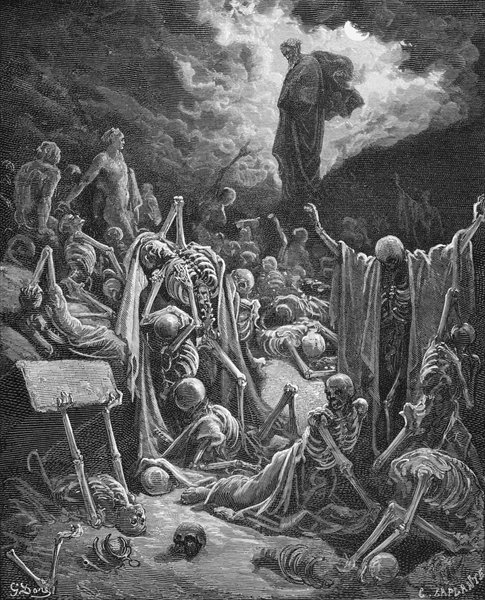
God showed Ezekiel a vision. It had to do with a with the death of national Israel and resurrection, but what does this resurrection in the valley of the dry bones represent? Let's look at a passage of Scripture that gives us a feeling for this third definition of death.

Then He said to me, "Son of man, these bones are the whole house of Israel. They indeed say, our bones are dry, our hope is lost, and we ourselves are cut off!' Therefore prophesy and say to them, thus says the Lord GOD: "Behold, O My people, I will open your graves and cause you to come up from your graves, and bring you into the land of Israel. Then you shall know that I am the LORD, when I have opened your graves. I will put My Spirit in you, and you shall live, and I will place you in your own land. Then you shall know that I, the LORD, have spoken it and performed it," says the LORD.'" (Ezekiel 37:11-14)

The land of Israel is often referred to as the Promised Land because of God's repeated promise (Gen. 12:7, 13:15, 15:18, 17:8) to give the land to the descendants of Abraham. The land is described repeatedly in the Torah as a good land and "a land flowing with milk and honey" (e.g., Exodus. 3:8).

The rule of Israelites in the land of Israel starts with the conquests of Joshua (ca. 1250 BCE). The land of Israel was central to Judaism. In 587 BCE, Babylonian Nebuchadnezzar's army captured Jerusalem, destroyed the Temple, and exiled the Jews to Babylon (modern day Iraq).

During the Babylonian captivity Israel was cut off from her homeland. They spent seventy years in another country. While Israel was cut off from the promised land she was in the sight of God, as dead! Israel was not in her rightful place because of her sin.

All these Jews were alive physically, but as the Lord showed Ezekiel 37:11 they were a valley of dry bones (in a grave nationally). When the Israelites were living in exile outside of the land of Palestine, they were (figuratively dead and in a grave).

God in restoring His covenant people back into their own land uses the figure of graves opening and His people coming forth in (a national resurrection). Thus says the Lord GOD: "Behold, O My people, (I will open your graves) and cause you to come up from your graves, and (bring you into the land of Israel) (Ezekiel 37:12) When the Jews were living inside of the land they were all live nationally.

It is obvious from this scripture that God sees life and death independent of the physicality of man. If you now understand this third definition of death (national Israel was cut off from the promised land), then you possess a valuable tool in the understanding how God uses figure language.

Saturday, January 28, 2012

Does studding Eschatology for yourself really Matter?

Why is the study of eschatology important? First, the Bible is given to us that we might know God’s love for us and how God redeemed us to bring us back into His very presence.

Anything God has chosen to reveal to us is certainly worth studying. It seems odd, therefore, that Christians would opt to downplay certain parts of God's revelation as irrelevant.

Second, while eschatology may not be among the essential doctrines of the faith, neither is it unimportant. Eschatology deals with God's plan in human history. The Bible also tells us about God in eschatological passages. How can anyone say that God's plan for the human race has no effect on one's life?

In general, I find those who claim that eschatology has no effect on one's lifestyle to be those with a pessimistic view of the future. Eschatology affects one's perseverance. Eschatology has a very profound effect on one's life. You better believe eschatology matters. As a man thinks, so is he (Prov. 23:7). In my last article we say how the church became greatly influenced by gentile thinking and how their ideas of the last day’s are totally alien to Judaism and Old Testament scripture.

But did this influence creep in on other parts of the Bible like the nature of the "Parousia of Christ that was to happen in the last days as well. Now Listen to these suggestions by Kurt Aland as we discover a decisive turning point in the second half of the second century a watershed decisive for the development of the Christian church. Think deeply about these things.

It was the definite conviction, not only of Paul, but of all Christians of that time, that they themselves would experience the return of the Lord; The Apocalypse expresses the fervent waiting for the end within the circles in which the writer lived-not an expectation that will happen at some unknown point x in time, but one in the immediate present. If we browse through the writings of that period we observe that this expectation of the end continued. In fact, we also find the writing of the first half of the second century sufficient evidence to indicate that the expectation of the Parousia was by no means at an end then.

At the end of the Didache ("the teaching of the twelve apostles"), from the time shortly after 100, there is, for example, an apocalyptic chapter, which corresponds completely in its outline to the Synoptic apocalypse in Mark 13 (and the parallel chapters in the other Synoptic Gospels.); here we can only very cautiously say that it used the same words, but that its content is imperceptible in the process of change. It's quite similar to the Epistle of Barnabas, which was written a little later that the Didache, where we read: (The day is near in which everything will perish together with the evil. The Lord and his recompense are near.

Again and again the old expressions echo. They echo apparently almost unchanged, but ("doubt about the imminence of the Lord’s return is increasingly mixed with them until around the middle of the second century, when the Shepherd of Hermas thinks he has found a solution and expresses it with great thoroughness and emphasis: the Parousia-the Lord’s return-has been postponed for the sake of Christians themselves. The building of the tower has not been stopped,) it is only temporarily suspended. Therefore and this is the warning of the Shepherd of Hermas, on account of which the entire work was really written do good works for your purification, for if you delay too long, the construction of the tower may be finished and you will not be included as stones built into it.

The thought of a postponement of the Parousia appears all through 2 Clement but here it is expressly mentioned for the first time. Thus, about the middle of the second century, a decisive turning point occurs one which can be compared in significance to all other great turning points, including the Reformation. Obviously, we cannot fix this turning point precisely at the year 150, for it took a while until the though caught hold everywhere. But a development does begin with the Shepherd of Hermas which could not be stopped-a development at the end of which we stand today. As soon as the thought of a postponement of the Parousia was uttered once and indeed not only incidentally, but thoroughly presented in an entire writing-it developed its (own life and power).

At first, people looked at it as only a brief postponement, as the Shepherd of Hermas clearly expresses. But soon, as the end of the world did not occur, it was conceived of as a longer and longer period, until finally-this is today’s situation nothing but the thought of a postponement exists in people’s consciousness. (Kurt Aland. A History of Christianity. (2 vols.) Fortress Press: 1985. Vol. 1,pp.89-102

Above we have heard from a well-known students of Church history who pointed the middle of the second century as the time when a paradigm shift in eschatological concepts occurred. Did all these statements of history just come out of the thin air? These are pretty powerful statements, and they're coming from someone who knows a decisive turning point" when he sees one.

These and other statements made by other students of Church history are not hided in the dark all it takes is a little research to learn the truth of the matter. Does studding Eschatology for yourself really Matter?

Sunday, January 22, 2012

The last days.

After the destruction of Jerusalem in A.D. 70 a great number of Jews’s were killed or taken captive and sold as slaves. Concerning Jerusalem, Moses said, in Deuteronomy 28:68 "And the LORD will take (you back to Egypt in ships, by the way of which I said to you), 'You shall never see it again.' And there you shall be offered for sale to your enemies as male and female slaves), but no one will buy you." (emphasis added)
The tallest and most beautiful of the young men were saved for the triumphal procession; everyone else over the age of seventeen was sent in bonds to work the Egyptian mines. A great number were also sent into the provinces to provide amusement in the theaters. (Josephus 37:B.C A.D. 70 p. 230)

At the rise of Christianity anti-Semitism and hatred of Jews began to creep into the church toward the Jews just because they are Jewish. The church became greatly influenced by gentile thinking such as the Church, was God’s plan B after the Jews reject their Messiah. However the birth of the early first century Church was brought about from within the womb of Judaism. The Church was thoroughly Jewish from its earliest days (since there were no Gentiles in it from 32 to 42). When the Gentiles did begin to come into the church it was at the council in Jerusalem. ( Acts 15)

Along with the gentile influence came the idea of the last days on the New Covenant. However, in order to determine whether we are in the last days, we should determine how the phrase was originally used in the Hebrew Scriptures. This will help us in regards to our interpretation of the New Testament usage of the term "last days."

First, I would like to consider the first usage of the phrase "last days" and consider those who are primarily addressed: Genesis 49:1 And Jacob called unto his sons, and said, Gather yourselves together, that I may tell you that which shall befall you in the last days. So, it is clear that Israel is the subject of Jacob ‘s swan song about the last days and the last days concern the Jews.
 

Moses confirms that in the latter days the Jews would be ultimate scattered among the nations. Deuteronomy 4:27 And the LORD shall scatter you among the nations, and ye shall be left few in number among the heathen, whither the LORD shall lead you. Deuteronomy 4:30 When thou art in tribulation, and all these things are come upon thee, even in the latter days, if thou turn to the LORD thy God, and shalt be obedient unto his voice.

Moses says, the Jews would be scattered among the nations in a (time of tribulation that will come upon them in the latter days). There is no reference to Gentiles being the subject of these latter days.

Was the nation of Israel ultimately scattered among the nations in a time of tribulation? You bet they were, many were taken back to Egypt in ships, to work the Egyptian mines. (Deuteronomy 28:68 concerning Jerusalem) "And the LORD will take you back to Egypt in ships, by the way of which I said to you, 'You shall never see it again.' And there you shall be offered for sale to your enemies as male and female slaves, but no one will buy you." (emphasis added) (Josephus 37:B.C A.D. 70 p. 230)

Moses continues this omen toward the end of the book. Deuteronomy 31:29 For I know that after my death you will utterly corrupt yourselves, and turn aside from the way which I have commanded you; and evil will befall you in the latter days; because you will do evil in the sight of the LORD, to provoke him to anger through the work of your hands. Moses was speaking to a nation of Jews, who evil will befall in the latter days; because they did evil in the sight of the LORD,

Ezekiel identifies Israel also concerning its doom under the nations in the latter days. Ezekiel 38:16 And thou shalt come up against my people of Israel, as a cloud to cover the land; it shall be in the latter days, and I will bring thee against my land, that the heathen may know me, when I shall be sanctified in thee, O Gog, before their eyes. Nowhere in these passages are referring to the last days of the physical planet, but, rather, the last days of Judah and Jerusalem.

Isaiah predicts these last days as well. Isaiah 2:1-2 The word that Isaiah the son of Amoz saw concerning Judah and Jerusalem. And it shall come to pass in the last days, that the mountain of the Lord's house shall be established in the top of the mountains, and shall be exalted above the hills; and all nations shall flow unto it. The vision was concerning Judah and Jerusalem not the physical planet.

Throughout the Old Testament God predicts when these latter days come the people of God will understand what He will do to the nation of Israel in destroying it and punishing it for its wickedness.

Along with the punishment of the fleshly nation of Israel for its wickedness, the elect remnant of national Israel would be saved in the latter days. Hosea 3:5 Afterward shall the children of Israel return, and seek the LORD their God, and David their king; and shall fear the LORD and his goodness in the latter days.

The fear here is one of reverence in those who worship and serve the God. In the Old Testament, “reverence” occurs as the translation of two Hebrew words: Yare’ (pronounced yaw-ray’), which carries the meaning of “fear.” This word is used to express the attitude toward God Himself. “God is greatly to be feared in the assembly of the saints, and to be had in reverence of all them that are about him (Psalm 89:7). The thought was one of fear, awe and respect.

Certainly the writers of the New Testament were very aware of those passages we studied involving the last days of Judah and Jerusalem. Therefore, it is safe and logical to say Paul believed they were living in the end of the Jewish age as well: 1 Cor 10:11 Now all these things happened unto them for examples and they are written for our admonition, upon whom the ends of the age are come.

Paul was describing the history of the Jews and their rebellion against God in the wilderness. We should not ignore the fact that Paul, is discussing the ancient rebellion of Israel, which took place in the wilderness before entering into the earthly promised land, was describing the rebellion taking place during the 40-year period in which he was living in the period between the giving of the New Testament and the entering into the heavenly Promised Land.

It is evident that national Israel is the main subject involved in these last days. However, one might try to argue that the last days concerned the spiritual Israel of God. One would be hard pressed to find scripture where God is bringing such evil upon His beautiful bride.

Consider the statement of Daniel about an everlasting kingdom. How great are His signs, And how mighty His wonders! His kingdom is an everlasting kingdom, And His dominion is from generation to generation. Daniel 4:3

Daniel 7:14 Then to Him was given dominion and glory and a kingdom, That all peoples, nations, and languages should serve Him. His dominion is an everlasting dominion, Which shall not pass away, And His kingdom the one Which shall not be destroyed..

Daniel 7:27 Then the kingdom and dominion, And the greatness of the kingdoms under the wholes heaven, Shall be given to the people, the saints of the Most High. His kingdom is an everlasting kingdom, And all dominions shall serve and obey Him.'

Hebrew 13:20 Now may the God of peace, who brought up our Lord Jesus from the dead, that great Shepherd of the sheep, through the blood of the everlasting covenant. Of course you cannot place last days on an everlasting covenant.

The point is most, if not all the disciples were dead not long after the start of the early Church. And there understand about the last days from the Old Testament scripture died with them. As the Gentiles began to come into the Church they gave birth to a last day totally alien to Judaism and Old Testament scripture.

2 Peter 3:13 Nevertheless we, according to His promise, look for new heavens and a new earth in which righteousness dwells.

It has been generally believed that Peter here is saying there will be a new physical heaven and earth after the old earth and solar system are destroyed. At first glance, it looks as though Peter was saying just that. But are the physical world and universe, what Peter had in mind? There is a lot more to this statement of Peter that meets the eye.

In order to understand what Peter is trying to convey about the “new heaven and earth” we need to think like an Israelite who was familiar with the flood of Noah. The Jews had another understand of the heaven and earth, then our modern literal understanding.

Let go back to 2 Peter 3:5-7 For this they willfully forget: that by the word of God the heavens were of “old,” and the earth standing out of water and in the water, by which the world that then existed perished, being flooded with water. But the heavens and the earth, which are now preserved by the same word, are reserved for fire until the day of judgment and perdition of ungodly men.

Notice the context of what Peter writes in these verses 5. The “old” heavens and earth (that then existed) are the same heavens and earth that rain destroyed in Genesis. And rain fell upon the earth forty days and forty nights. (Genesis7:12)

So, the post flood heavens and earth that then existed are the “old” heaven and earth when Peter was writing. The reason the “old” heaven and earth were destroyed in the days of Noah was because of ungodly men who were thoroughly corrupt upon the earth in God's sight. Genesis 6:5 Then the LORD saw that the wickedness of man [was] great in the earth, and that every intent of the thoughts of his heart was only evil continually.

The “heavens and earth” that existed after the flood, Peter calls the “now “ heaven and earth in (2 Peter 3:7). Peter also says the reason for the destruction of the current heavens and earth was ungodly men. Peter continually links the two events together. The difference between the two events are the method of judgment. The heavens and earth of Noah’s day were destroyed by water and the heavens and earth Peter refers to are destroyed by fire. Some, who take the literalistic interpretation approach to all prophecy, apply this to the end of the world's history. But prophecies like this actually applied to spiritual things the passing away of the old order, and the transformation of things into newness of life.

Here are two dilemmas with our old modern interpretation that the heaven and earth Peter is referring to are the material world, and universe that will be burned up. Why should we think that fire will destroy (the Glob and Universe) when Peter uses the example of the “old” heavens and earth (that existed) were destroyed in Noah’s flood? We need not. The flood did not destroy the literal heavens and earth, as Peter refers to its destruction. (2 Peter 3:5) The people came under judgment by water. The literal heavens and earth were not destroyed. Peter explains the earth was standing out of water and in the water.

The second dilemma. Have you ever thought to yourself if the literal heaven and earth were destroyed in the days of Noah's flood were did the “now” heaven and earth that Peter mentions will be destroyed by fire come from? It's obvious that Peter had something else in mind other then the literal planet and universe burning up.

ISRAEL was the heavens and the earth that God had formed, and some day that same heavens and earth would pass away as described in (2 Peter 3). In Isaiah 51:13 God said that He had "stretched forth the heavens, and laid the foundations of the earth" Once again, is God speaking here of the literal heavens and earth?

Read on in this same passage to verse 16: "And I have put my words in thy mouth, and I have covered thee in the shadow of mine hand, that I may plant the heavens, and lay the foundations of the earth, and say unto Zion, Thou art my people."

This could not be talking about the formation of the literal heavens and earth, for that had taken place more than 3,000 years before! The verse explains itself. He is talking about "Zion." He is talking about "my people Israel" In other words, He is talking about the formation of Israel or the creation of Israel.

In Jeremiah 22:29 God says, "0 earth, earth, earth, hear the word of the Lord." And in verse 1 (along with verses 11, 18 and 24) we read that the words were for the people of Judah, concerning the time when they would be taken "into the hand of Nebuchadnezzar king of Babylon, and into the hand of the Chaldeans" (vs. 25). It was not the whole physical earth, God was talking to, but the people.

The new heavens and earth that Peter mentions where righteousness dwells are based upon "GOD’S PROMISE" The only prophecies "promise" that Peter referred to are in the Old Testament that specifically mention the new heavens and new earth are found in Isaiah 65:17 and Isaiah 66:22.

These are the only two places in the Old Testament where this promise of a new heaven and a new earth can be found, and neither of these speak of a literal heavens and earth passing away. Nor do they speak of a literal new heaven and new earth.

The heaven and earth, in which Peter is referring to in Genesis and 2 Peter 3 are Bible language referring to change or transformation, from an old order and making into a new thing, of God's people.

The Old Covenant was obsolete and growing old and ready to vanish away. (Hebrews 8:13) In that He says, "A new covenant," He has made the first obsolete. Now what is becoming obsolete and growing old is ready to vanish away.

The elements will melt with fervent heat.

Most people are naturally prone to accept without question the teaching from a person or organization they hold in high regard, never considering or presuming that they could be teaching something based upon an assumption or preconceived notion they were taught. It may be that many of us have come to understand these verses based on prior traditional assumptions.

We need to examine the meaning of this word "elements", which is the same word used several other times in the New Testament. The Greek word for "elements" is "stoicheion" and means "something orderly in arrangement - element, principle, rudiment."

The word itself can refer to the parts of which our universe. It can also have another meaning it can refer to the rudimentary things of religion as well as other things too, of course. Perhaps we should consider what other scriptures may have to say on this matter of “the elements” and how the word is used? At this point in our study will look at the symbolic meaning of the passing away of the heavens and the earth, in connection with the "elements.” The elements would be the done away with the things related to Israel’s religion which would be abolished.

We find this word first in Galatians 4:3 where Paul said, "Even so we, when we were children, were in bondage, under the elements "stoicheion"of the world." Here Paul was saying that the Jewish people before Christ and salvation were living under the worldly ceremonies and ordinances of the old covenant, though now they no longer needed the law as a schoolmaster as they had graduated to Christ by faith. The elements "stoicheion" were no longer needed. When they were under the Mosaic, law before Christ they were in bondage, under the elements "stoicheion"of the world."

The Jewish leader believed just because they were fleshly descendants of Abraham that they had never been under this bondage. However, Jesus pointed out whoever commits sin is a slave of sin and bondage. (John 8:33-34)

Then in Galatians 4:9 the word is used again. "But now, after that you have known God, or rather are known of God, how turn you again to the weak and beggarly elements, whereunto you desire again to be in bondage?" Paul follows this by saying that because "You observe days, and months, and times, and years;" verse10. He was afraid he had bestowed his labor upon them in vain. Paul used the term in his stinging rebuke to the Galatians Christians who were tempted to forsake the freedom of the New Covenant for an Old Covenant "elementary" style legalist religious system. The things of that legalist system would shortly be "burned up."

In Colossians 2:8 Paul encourages the Colossian Christians not to go back into these elementary things of the old law. He uses the same word for "elements" ("stoicheion") though here translated "principles" "Beware lest anyone cheat you through philosophy and empty deceit, according to the tradition of men, according to the basic principles of the world, and not according to Christ." The spiritual lives of these Christians could be spoiled if they listened to those Judaizers who tried to get them to return to the old way. These things would soon go up in smoke.

Then in the same chapter, Colossians 2:20, Paul said, "Wherefore, if you be dead with Christ from the elements ("stitching") of the world, why, as though living in the world, are you subject to ordinances ... " These ordinances would soon "perish" (be destroyed) he said (vss. 22).

The writer to the Hebrews says, "For though by this time you ought to be teachers, you have need again for someone to teach you the elements (stoicheion) of the oracles of God, and you have come to need milk and not solid food" (Hebrews. 5:12). In context, the writer to the Hebrews is clearly speaking of Old Covenant truths, particularly since he connects it with the term oracles of God, an expression used elsewhere in the New Testament for the provisional.

These words are a complaint, which the apostle makes a certain defect in the Christian Hebrews, to whom he wrote. What is the defect? The apostle complains was they had not made that progress in their acquaintance with the things of the law or things taught in the oracles of God, which they should have made by then. They should have been moving behind the knowledge of elementary things and teachers spiritual things in Christ. Yet they were still in need of the milk of the word and not solid food.

If these other five places are using the word "elements"(stoicheion) in terms of the old legalist religious system why would we think the meaning in 2 Peter 3:10 would not mean the same thing as in these other places?

When Peter said "the elements shall melt with fervent heat" in II Peter 3:12 the Greek word for "melt" there is "teko which means "to liquefy" But interestingly, in verse 10 where those same identical words (in English in the King James version) are used: "the elements shall melt with fervent heat", the Greek work for "melt" is different. It is "luo", which means "break up, destroy, dissolve, loose, melt, put off." In actuality, this is what happened to those "elements" of the old Jewish religion - they were broken up, destroyed, dissolved, loosened and put off. This is how the elements melted during that day of the Lord, when the heavens and the earth felt the judgment of God.

Until we learn to set aside our modern gentile traditional understand about these things and think like a first century Jew who was familiar with this style of figurative language out understanding of the Bible will forever be on the milk of the word and not solid food.

With the Lord a day is like a thousand years, and a thousand years are like a day.

The Lord is not slow in keeping his promise, as some understand slowness. He is patient with you, not wanting anyone to perish, but everyone to come to repentance. (2 Peter 3:8) In order to truly understand any context of scripture, it must be understood in it's original historical setting. The main principal design of this chapter is to demonstrate, an objection to the scoffers, that the Lord Jesus had not returned.

We will start with 2 Peter 3:2-4 which reads, that you may be mindful of the words which were spoken before by the holy prophets, and of the commandment of us, the apostles of the Lord and Savior, knowing this first: that “scoffers will come in the last days,” walking according to their own lusts, and saying, "Where is the promise of His coming? For since the fathers fell asleep, all things continue as they were from the beginning of creation."

Jude 1:18 says there would be "mockers in the last time of the old Covenant. Scoffers is the same Greek word rendered mockers. Now those days of Jude prophecy were being fulfilled.

These scoffers Peter mentioned, are Judaizers and unbelieving Jews that abandon God’s gracious gift of salvation and were trying to get Hebrew Christians to abandon the promise of Christ return. These Judaizers were mocking the Hebrew Christians by saying. "Where is the promise of His coming? For since the fathers fell asleep, all things continue as they were from the beginning of creation." These, "mockers" were Jews familiar with Jesus promise to return. (Matthew 10:23; 16:27-28; 26:62-65).

These scoffers were also very familiar with the events of the Old Testament. The argument of Peter, in reply to this is strong Peter began his scathing rebuttal to these mockers. He refers to the destruction of the old world by the flood--a fact that cannot be argued. Peter said that those scoffers knew very well what happened in the days of Noah, how the earth was standing out of the water and in the water. Verse 5 for this is unobserved by them willingly. However, they were willing to cast aside that knowledge and ignore it, as they made mockery of Jesus’ promise to come and destroy the then present “heavens and earth,” which was “reserved for fire, on the day of judgment of ungodly men” (verse 7).

In verse 8 we find a statement that has been quoted over and over again, but “not like it was originally written.” In 2 Peter 3:8 we find the statement about "one day being as a thousand years," etc. Please note the verse (does not say one day IS a thousand years with the Lord). But, beloved, be not ignorant of this one thing, that one day is with the Lord as a thousand years, and a thousand years as one day.

Peter was defending the promises of God’s word, especially the promises, against those scoffers who jeer and mock God's faithfulness. He was not in agreement with them. Peter wanted to assure his brethren not to fall prey to the words and claims of those evil scoffers that Christ had not returned as promised. They could count on it! Peter ministers to the household of faith as he strengthens them. He says, if God promises to do a certain thing in a day, the promise is sure, and it will come on time. If God promises to do a certain thing in a thousand years, the promise is sure, and it will come on time. It makes no difference to God, if the time is a day or a thousand years; God is faithful, to do what he promised. Verse 8 strengthens the sureness of the time statements made by Jesus in Scripture, they aren't opposing them. Peter was defending the promises of God, not agreeing with the scoffers.

Peter's thoughts are rooted in the Psalms: For a thousand years in your sight are like a day that has just gone by, or like a watch in the night. Psalm 90:4 This verse amplifies the teaching, saying that no matter how long time is from man’s perspective, it’s like a twinkling of an eye from God’s eternal perspective. Peter draws on these eternal truths to bring home the point that God is certain to keep his promises on time. Apostle Peter’s readers should not lose heart, because God keeps his promise on time.

What are the things that were continuing since the beginning of creation that the scoffers jeered and mocked the household of faith about? (2 Peter 3:4) The system of Moses with its priest hood, and animal sacrifices and the Temple. All these things were continuing when Peter wrote these words.

In fact, these may have been the very same scoffers who were brought false witnesses to testify against Stephen. There we read, Now Stephen, filled with grace and power, was working great wonders and signs among the people. Certain members of the so-called Synagogue of Freedmen, Cyrenians, and Alexandrians, and people from Cilicia and Asia, came forward and debated with Stephen, but they could not withstand the wisdom and the spirit with which he spoke. Then they instigated some men to say, "We have heard him speaking blasphemous words against Moses and God." They stirred up the people, the elders, and the scribes, accosted him, seized him, and brought him before the Sanhedrin.

They presented false witnesses who testified, "This man never stops saying things against (this holy place) and the law. For we have heard him claim that this Jesus the Nazorean will destroy this place and change the customs that Moses handed down to us." (Acts 6:9-14 New American Bible)

The real purpose of this whole episode, is to introduce Stephen as one who comes against the Temple and the Mosaic law that was handed down to them. The Temple is the holy place mentioned in verse 13. Notice these people were claiming that Stephen said Jesus will destroy this place (the Temple) and change the customs (the laws) that Moses handed down to us." This statement was made long after Jesus ascended to the right hand of the Father.

The scoffers Peter writes about were jeer and mocking about the faithfulness to this promise. But what was the reason Jesus had not yet come? The answer to that question is found in a verse that has long been forgotten and completely removed from the context of verse 8 Peter said, “The Lord is not slow about His promise, as some count slowness, but is patient toward YOU; not wishing for any to perish but for all to come to repentance.” (2 Peter 3:9)

The word translated "slow" (Greek "braduno") means just that. Another beautiful truth that is expressed here is that Peter, reminded them once again of the patience and long-suffering of God. The delay should be regarded as a proof of God, forbearance, and of his desire that men should be saved.

God wanted, 40 years for his old covenant people, to come to repentance, and not reject the salvation, of which Peter and Paul and others spoke of. After those 40 years of patience were over Jesus fulfilled his promise and the things that the scoffers were bragging that we're continuing were destroyed including the scoffers.

Wednesday, January 11, 2012

The concept of the Marriage Supper is also better understood in light of the wedding customs in scripture.

The Marriage Supper of the Lamb is a magnificent occasion. It stands out. It is alluded to in the Hebrew prophetic poetry. It is time of voicing great joy and gladness. The words of the wedding ceremony are, from Psalm and Isaiah… as the bridegroom rejoices over the bride, so shall Elohim rejoice over you. Isaiah 62:5 Psalms 19:5 Which is like a bridegroom coming out of his chamber, And rejoices like a strong man to run its race. Psalm 30:11-12 You have turned for me my mourning into dancing; You have put off my sackcloth and clothed me with gladness.

At the Marriage Supper the bride and bridegroom are elaborately clothed. Passages of scripture also allude to this practice. They would act and be treated like a king and a queen, even being adorned with crowns. Song of Solomon. 3:11 "Go forth, O daughters of Zion, and gaze on King Solomon with the crown with which his mother has crowned him on the day of his wedding, and on the day of his gladness of heart."

Isaiah 61:10 For He has clothed me with garments of salvation, He has wrapped me with a robe of righteousness, as a bridegroom decks himself with a garland, and as a bride adorns herself with her jewels.

Ezekiel 16:8-13 When I passed by you again and looked upon you, indeed your time was the time of love; so I spread My wing over you and covered your nakedness. Yes, I swore an oath to you and entered into a covenant with you, and you became Mine,” says the Lord GOD. “Then I washed you in water; yes, I thoroughly washed off your blood, and I anointed you with oil. I clothed you in embroidered cloth and gave you sandals of badger skin; I clothed you with fine linen and covered you with silk. I adorned you with ornaments, put bracelets on your wrists, and a chain on your neck. And I put a jewel in your nose, earrings in your ears, and a beautiful crown on your head. Thus, you were adorned with gold and silver, and your clothing was of fine linen, silk, and embroidered cloth.

If you wanted people to think of the most joyous special celebration they could think of, you would pick the wedding feast. Especially in that ancient Near Eastern culture. People really knew how to do it up big when it came to wedding feasts. The celebration might last for days or weeks. They pulled out all the stops richest of foods and the finest of wines, freely flowing. (John 2:1-12) It is a glorious celebration of all who had faith in God and since they are in a spiritual state there no need for food or drink! Ecclesiastes 12:7 Then the dust will return to the earth as it was, And the spirit will return to God who gave it.

The wedding feast to which the saints are invited includes not only the first century saints as the bride of Christ, but others were invited to the wedding feast as well. The "others" include all the Old Testament saints who die in faith like Abraham, and Isaac and Jacob.

In Luke 13, Jesus talked about Abraham and Isaac and Jacob and all the prophets of Israel–as well as a multitude of people from the east and west and north and south. All of them “reclining at a table in the kingdom of God.” “Reclining at table” That’s the image of an ancient Near Eastern feast, which Jesus uses to describe the kingdom of God.

This are the ones invited. “Blessed are those who are invited to the marriage supper of the Lamb” (Revelation 19:9). The main purpose of the wedding feast is “ worship and praising God” for all that He has done. Jeremiah 33:11 'the voice of joy and the voice of gladness, the voice of the bridegroom and the voice of the bride, the voice of those who will say: "Praise the LORD of hosts, For the LORD is good, For His mercy endures forever" and of those who will bring the sacrifice of praise into the house of the LORD. For I will cause the captives of the land to return as at the first,' says the LORD

In his vision John saw and heard the heavenly multitudes praising God because the wedding feast of the Lamb the "marriage supper"—was about to begin. Revelation. 19:6-9 And I heard, as it were, the voice of a great multitude, and as the sound of many waters, and as the sound of mighty peals of thunder, saying, "Hallelujah! For the Lord our God, the Almighty reigns. Let us rejoice and be glad and give the glory to Him, for the marriage of the Lamb has come and His bride has made herself ready." And it was given to her to clothe herself in fine linen, bright and clean; for the fine linen is the righteous acts of the saints. And he said to me, "Write, blessed are those who are invited to the marriage supper of the Lamb.'" And he said to me, "These are the true words of God."

There is another very important point that is often overlooked about the Marriage Supper of the Lamb. There are three phases to the marriage supper itself. First, a marriage contract between the parents of the bride and the bridegroom. The bridegroom would pay a dowry to the parents of the bride. This was called the betrothal period, what we would today call the engagement.

The second step usually occurred a year later, when the bridegroom, accompanied by his male friends, went to the house of the bride at midnight with a torchlight parade through the streets. The bride would be ready with her maidens, and they would join the parade that would end up at the bridegroom's home.

The third phase was the Marriage Supper of the Lamb itself, as illustrated Revelation. 19:6-9 What John visioned the wedding feast of the Lamb (Jesus Christ) and His bride (the Church) in its “ third phase, the implication is the first two phases leading up to the Marriage Supper had already taken place.” So there no way Revelation was written after AD 70 when the bridegroom came for his bride.